Srilankan history (Polonnaruwa Kingdom-1)
THE POLONNARUWA KINDOM
POLONNARUWA AS A DEVELOPED SUB CITY OF THE KINGDOM OF ANURADAPURA
|
||||
The Cholas captured Mahinda 5 alive at the end of his reign of thirty six years. According to the above account, the last king of the Kingdom of Anuradhapura,Mahinda 5 had been captured by the Cholas after he had ruled the country for 36 years.Moreover,Mahinda 5 had been taken to the Chola country as a captive.
In 1017 A.C the Chola Emperor Rajendra I subjugated Rajarata. The regions subjugated in this manner became provinces of the Chola Kingdom and were named “Mummudi Chola Mandalam” The Chola rulers abandoned Anuradhapura which was the capital of Sri lanka for about one thousand five hundred years and selected Polonnaruwa as their kingdom.As mentioned above the fact that the Cholas too realized the importance of Polonnaruwa made a good reason for them to shift their capital.
Chola Rulers named Polonnaruwa as “Jnanatha Puram.”
Now let us find information about the Chola regime of Rajarata. · Sri Lanka was under the Cholas from 1017A.C to 1070A.C. · The administration was carried on by a Commander appointed by the Chola Emperor of South India. Chola officers were appointed for higher ranks. · Ransom and gifts were sent annually to the Emperor by the officers including the Commander. · Shiva Devalas No 1 and 2 were built in Polonnaruwa for their religious rituals. · Chola rule was mostly of a military character. On and off they invaded Ruhunu area. · Vast damage was done to Buddhist places of worship owing to Chola invasions.
|
Administration of Vijayabahu 1 Vijayabahu 1 was known as Prince Kitti when he was small. Much information about this prince is revealed in the “panakaduwa” copper plate installed by him. It mentions that a regional ruler named “Budalna” Gave protection to him in his young days.Vijayabahu 1 has even received assistance from him to win Rohana.
King Vijayabahu 1 redeemed Rohana from internal conflicts and made Kataragama his head quarters in 1055 A.D. He directed three troops of armies along three routes, attacked and defeated the whole country frome Cholas in Rajarata.These three routes are shown King Vijayabahu 1 who redeemed the whole country from Chola rule in 1070A.D. held his victorious coronation ceremony in Anuradhapura.But it was Polonnaruwa that was made his administrative centre.
King Vijayabahu 1 who united the country was also methodical in his administration. Virabahu, his brother who became the Crown Prince was appointed as the administrator of Dakkhina Deshay (southern area).He made the administrative affairs methodical and gave the individual officers a good knowledge about duties.
He felt that all the aspects which were in Anuradhapura should be there in Polonnaruwa too,and the first thing he did was erecting a temple for the Tooth Relic. It is said to be the Atadage now in ruins said to be as this.He had also built several monasteries in Polonnaruwa.
He did a valuable service for the development of the priesthood and he had also started to spread the practice of worship. Figure 1 depicts an instance of worshipping SriPada.
King Vijayabahu 1 got down Bikkhus from Burma and revived the practice of Higher Ordination. He did not discriminate against Hinduism and he had even patronized its advancement. An Inscription in the Hindu Temple of Vijayaraja Eshwaram situated in Kantale confirms this.
Economic Activities during the reign of King Vijayabahu 1
King Vijayabahu 1 took steps to improve agriculture and irrigation activities. He restored many tanks for this. He repaired the dents of the Elahara canal which supplies water to Minneriya Tank. Through this he connected Minneri, Kavdulu, and Kantale tanka and restored the drainage system. He also restored tanks such as Maha Kanadara,Nachchaduwa and Mahagal Kadawala tanks.
Foreign Relations of King Vijayabahu 1
The foreign policy of king Vijayabahu 1 was formed with the objective of protecting the country from South Indian invasions. For this he developed close relationships with the powerful kingdoms of South India. He had matrimonial relationships with kingdoms which were against the Chola Kingdom. He married a Kalinga Princess by the name of Thilokasundari and he gave his sister Princess Miththa in marriage to the Pandayan Prince . He maintained relationships with Chalukya kings too.Thre is no information to the effect that foreign invasions were attempted on the island during the reign of King Vijayabahu 1.
King Vijayabahu 1 got down Bhikkus from Ramanna and re-established the practice of Higher Ordination here.He had also sent offerings to the Maha Bodhi in Buddagaya in India.
Later there were many conflicts regarding kingship among the children and grand children born unto as a result of the matrimonial relationships of King Vijayabahu .
The Ambagamuwa Inscription mentions that King Vijayabahu possessed the good qualities such as worshiping the Triple Gem , respecting the Bhikkus, bowing down to justice ,favouring the scholars,hospitable, entertainment the friends and being kind to all beongs.
After this righteous ruler therensued chaos in the country again.Owing to these conflicts for succession to the throne the country came to be divided into four regions,namely,Rarata,dakkhina Desha,Dolosdahas Rata and Atadahas Rata
Figure 1 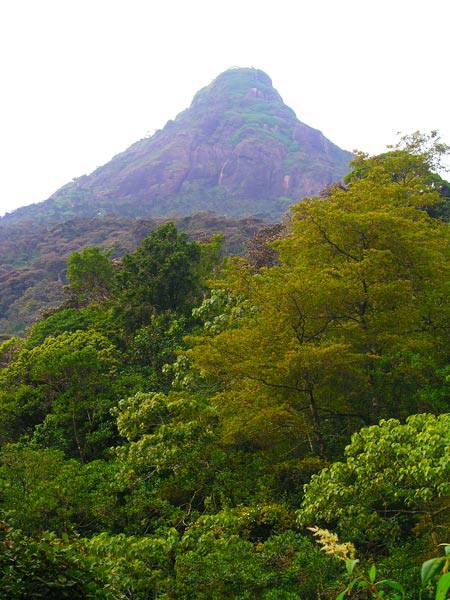 |
King Parakramabahu the Great was the son of Manabarana who ruled In Dakkhin desha. And his queen Ratnawali. The main ambition of Parakramabahu the Great who became king after Manabarana was to unify the country.Parakramabahu the Great who was skilled in the art of warfare defeated King Gajaba 2, but Bhikkhus intervened and made a formal agreement that one could rule only after the death of the previous ruler and settled them. This agreement appears in the “Sangmu” inscription .After the death of the Gajaba 2 around 1153 the coronation of Prakramabahu the Great was held and he became the Ruler of Rajarata. He made Polonaruwa his centre of administration
Although King Manabarana who ruled over Ruhunu died in 1154 his mother Queen Sugala made a threat to the power of Rajarata. But King Parakramabahau the Great defeated Sugala at Uruwel and Udundora and seized the Bowl Relac and the Sacred Tooth Relic. King Parakramabahu was able to unify Sri lanka by 1160.
The next objective of King Parakramabahu the Great who unified Sri Lanka was to develop religious and agricultural activities in the country. He united the priesthood who were divided into three sects and made a series of rules and regulations which the Sangha should adhere to. The inscriptions at Galvihara in Polonnaruwa testify too this. The Annual Higher Ordination ceremonies too were held during this period.
He built several new temples and monasteries and also renovated the rined places of worship. Some of them are Alahana Pirivena, Lankanthilaka Image house, Thivanka Image house , Gal vihara ,(image 1) Rupawathie Chaitya or Kirivehere (image 2) Pothugal vihara ,Mahatupaya or Demalamaha Seya.
In addition he had built a Chaitya named Sutiyagara in Dedigama which was his native village .
King Parakramabahu the Gret built large tanks such as Parakrama Samudraya the Restored the ruined tanks. On account of this kind of irrigation schemes there was a rapid development in the agricultural activities during this period.
Another objective of King Parakramabahu was to make Polonnaruwa a beautiful city. In addition to the temples, beautiful palaces, parka and ponds were built.(image 3 and 4). image 1 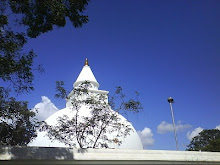 image 2 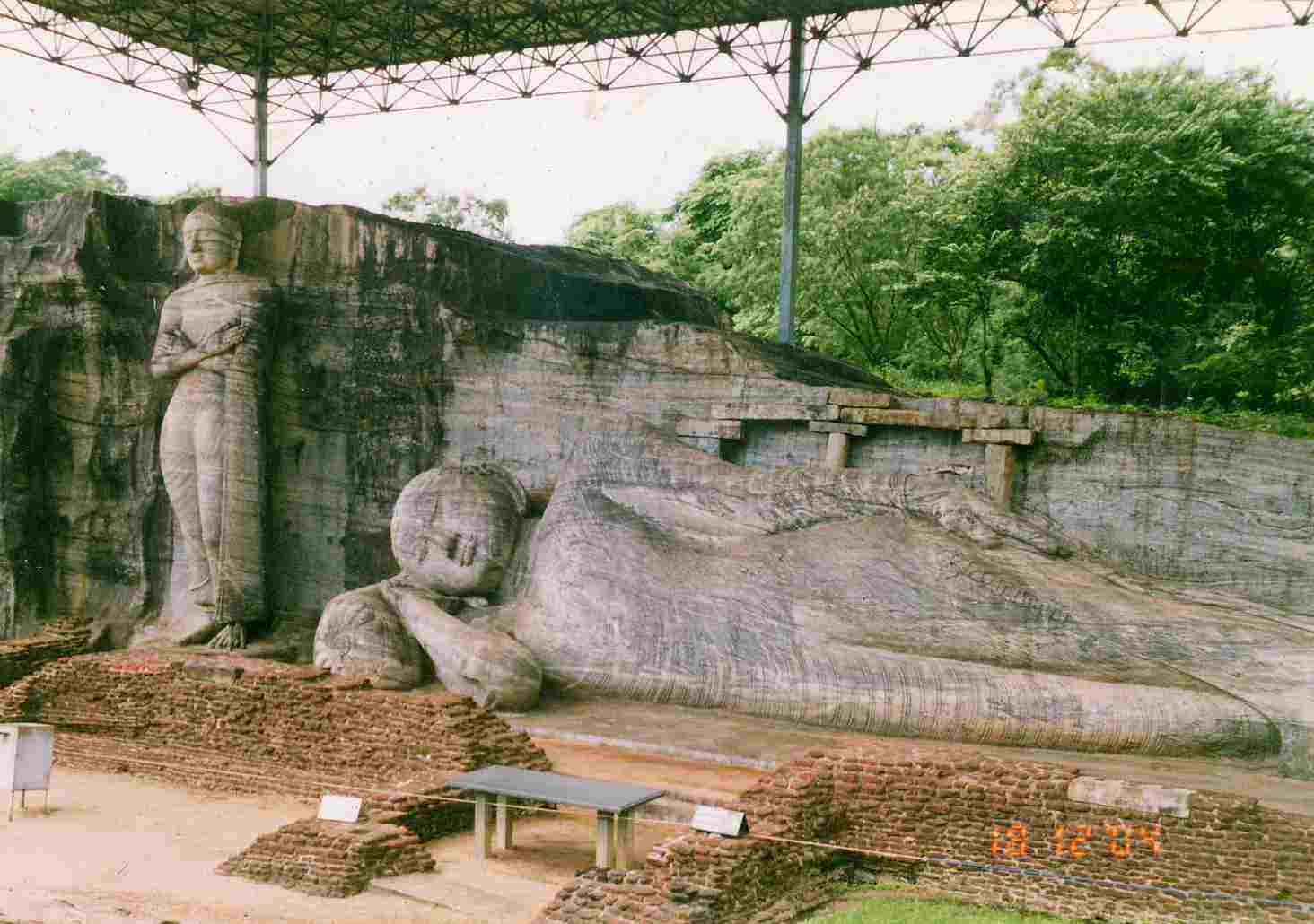 image 3 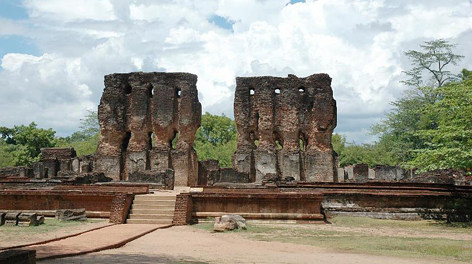 image 4 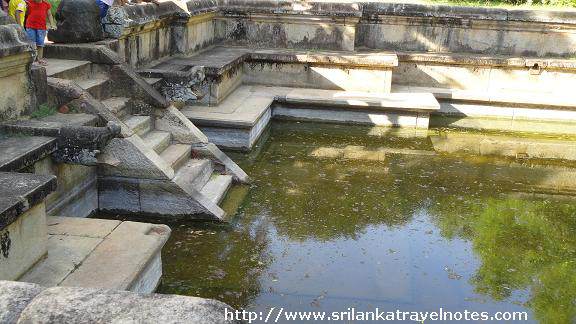 watch this video |
||
